
If You Give Up, They Will Too: Leadership and Example in Education
By Darwin Lozano
A reflection on homework, parental perseverance, teacher support, and conscious leadership at home.
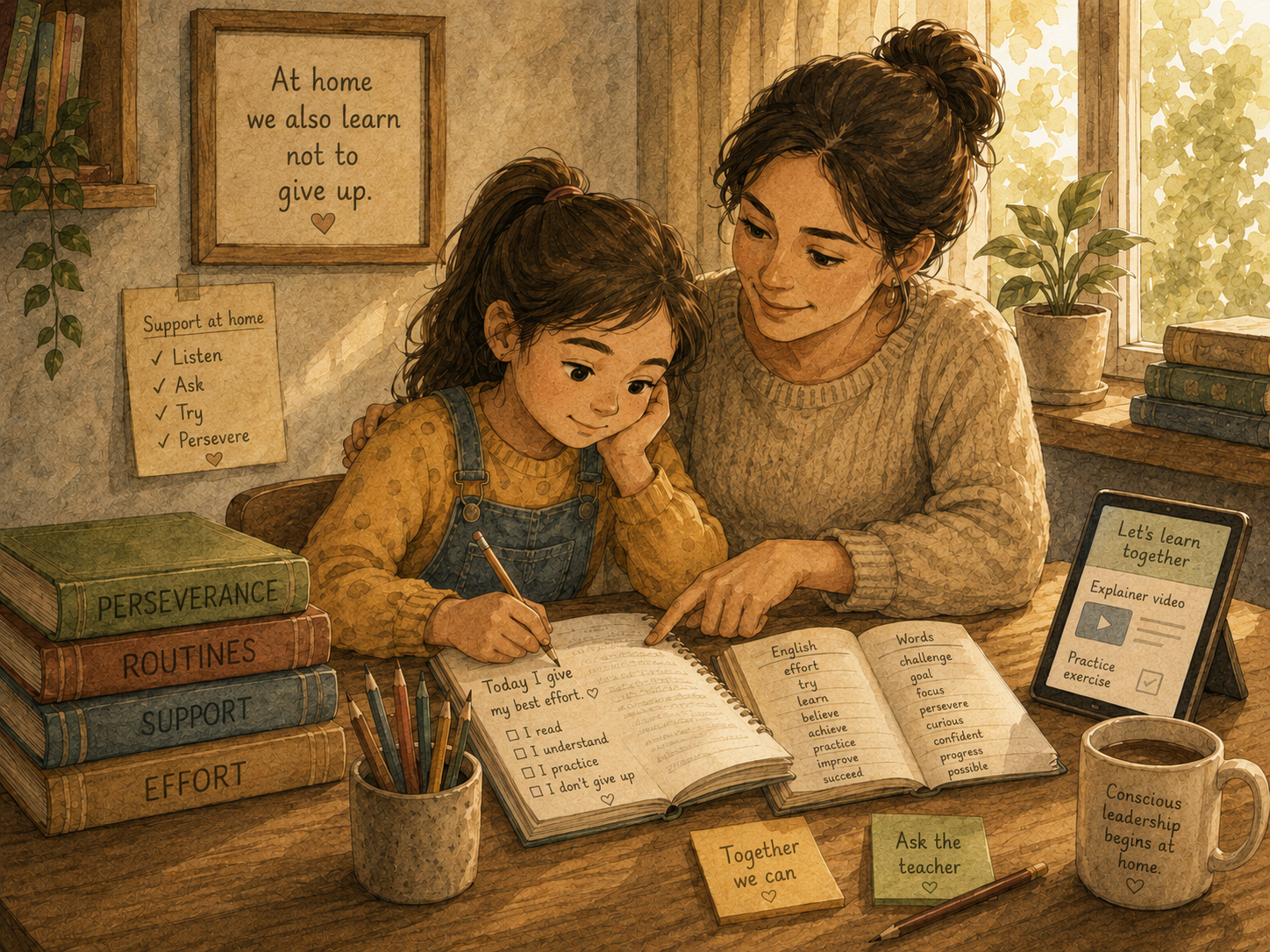
Homework can become an opportunity to teach perseverance. What children see at home can make the difference between giving up and continuing to try. Hi, I’m Darwin, and this week I want to reflect with you on that.
This week, I received a message from the mother of one of my students. She explained that the homework had been very difficult and, for that reason, her daughter would not be able to turn it in. The family speaks Portuguese and some English, so I understand the challenge.
The first thing I did was thank her for supporting her daughter. I know many parents work long, exhausting days, and sometimes it is hard to find the energy to sit down and help with schoolwork. Still, as I read her message, several questions came to mind: What happens when a parent gives up? What message does a child receive when they see mom or dad stop trying? And what can we, as teachers, do to make homework feel less like an impossible mountain and more like an opportunity to learn together?
The next day, my student returned to class with a shy smile and said:
“I’m sorry, Mr. D. My mom and I tried, but we didn’t understand and couldn’t finish the homework.”
I hugged her and told her not to worry, that we would solve it together. She is a sweet and hardworking girl. That moment reminded me of something important: children are always watching. If they see perseverance, they learn not to give up.
The Challenge
Many parents face real limitations: fatigue, language barriers, lack of time, or lack of confidence. I know this well because I lived it. My grandmother, who raised me, could not read or write. She was never able to help me with homework. I had to figure things out on my own, paying extra attention in class.
Today, the situation is different. We have internet, smartphones, and resources within reach. Still, in my classroom, I notice that about 40% of students turn in complete homework, 20% turn it in incomplete, and another 40% do not turn it in at all. The reasons vary: difficulty with the assignment, lack of confidence, tiredness after school, or, in some cases, limited support at home. It is not always a matter of ability; often, it comes down to perseverance and well-supported education at home.
What Experts Say
Research confirms the value of homework when it is well designed and supported:
- It reinforces learning: homework helps consolidate knowledge and memory.
- It builds habits and discipline: it encourages responsibility and consistency.
- It involves families: it opens dialogue about what children are learning and strengthens the school-family partnership.
- It can improve academic performance: when homework is clear, appropriate, and followed by feedback, it can improve grades and confidence.
The problem is not homework itself, but how we approach it at home and at school.
The Role of Teachers
Teachers share this responsibility too. I try to make sure homework does not take more than 30 minutes and that it truly helps students reinforce what they learned in class that day.
What can teachers do to make those minutes productive?
- Give each assignment a clear purpose and explain it in class.
- Design realistic and differentiated activities according to the student’s level.
- Offer choices that promote autonomy and motivation.
- Provide quick and positive feedback that recognizes effort and guides the next step.
When children understand why they are doing something and feel supported, homework stops being a burden and becomes a tool for growth.
Conscious Leadership at Home
Let’s return to the central question: is giving up really an option?
If a parent says, “I can’t,” and stops trying, the child will likely do the same. The message the child receives is: “If mom or dad can’t do it, then I can’t either.”
Conscious leadership is also lived at home. It means showing perseverance, calm, and resilience in the face of difficulty, even when you do not fully understand an assignment or a language. That example is more powerful than any academic explanation because it teaches children how to face challenges without giving up.
Some practical ideas for parents:
- Sit with your child and talk, even if you do not know all the answers. Your presence matters.
- Create routines with a fixed place, time, and materials ready.
- Keep a positive attitude: what your children notice most is not whether you know everything, but your willingness to try.
- Use helpful technology, such as translators, tutorials, and learning platforms, to reduce frustration.
- Communicate with the teacher: collaboration makes a difference.
Final Reflection
I walked the road of education mostly alone. Many times, I felt frustrated and even cried because I did not understand the homework. That was my reality. But today, our children do not have to repeat that story.
They have resources, teachers, and, most importantly, families who can make a difference through their example. If you give up, they will too. But if you persevere, your children will learn that effort is worth it. That may be one of the greatest gifts you can give them.
Conscious leadership does not demand perfection; it demands presence. At school, it means building bridges with families. At home, it means modeling resilience. When school and family work hand in hand, children do not give up: they learn, grow, and discover that they are capable.
The next time your child’s homework feels too difficult, don’t give up. Sit with them. Try together. Ask questions. Reach out to the teacher if you need to.
Your children will remember your effort more than your answers. And that example may be the spark that teaches them that giving up is not an option.
See you next week,
Darwin